Project subtitle / summary
The Hobbit website design was an independent academic project I created at SEDC in 2012. I worked on both the visual design and frontend implementation using HTML, CSS and JavaScript.
Duration
2012 — academic project at Seavus Education and Development Center (SEDC).
Tech stack
HTML, CSS, JavaScript, jQuery.
Overview
The Hobbit Website Design — An Academic Project
The Hobbit website design was a student project I completed independently at Seavus Education and Development Center in 2012. It brought together two parts of my learning: developing a visual concept and implementing that concept as a website.
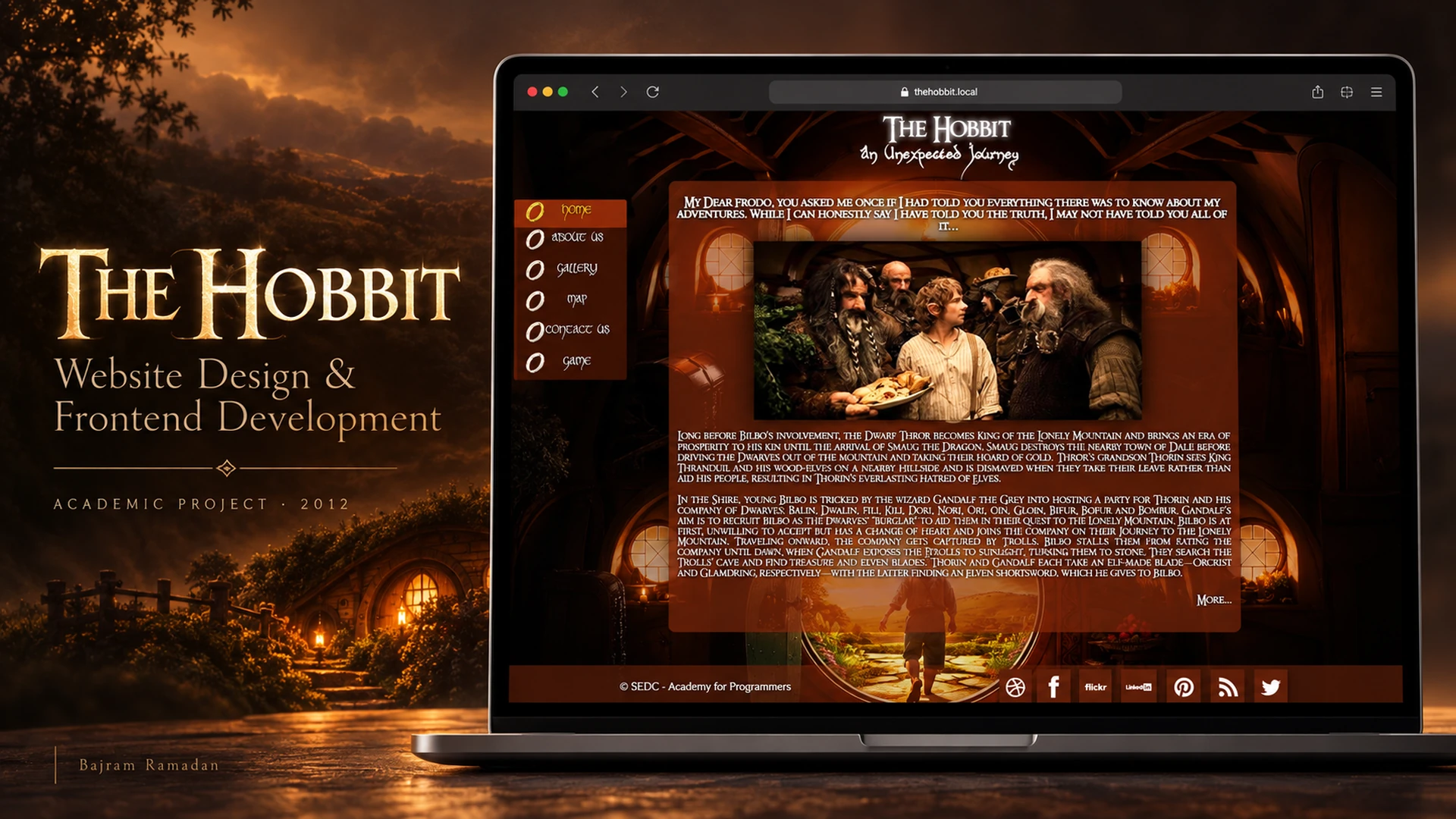
The project used the world of The Hobbit as its creative theme. A dark background, warm brown and orange panels, decorative typography and film imagery established the visual atmosphere. The supplied homepage screenshot preserves the design as part of my early development work.
The original website demo remains available as a historical example of the project.
The Challenge
The task was to turn a recognisable fantasy theme into a coherent website while practising the connection between design and code. The visual direction needed to work across the background, navigation, typography and central content area.
Working independently also meant taking responsibility for the whole student project. The design decisions and their frontend implementation belonged to the same process, making this an opportunity to explore how a composition translates into HTML and CSS.
My Role / Contribution
I worked on the project independently, handling both the website design and its frontend implementation.
My contribution covered the page composition, visual styling and implementation with HTML, CSS and JavaScript. The theme was inspired by The Hobbit, while the site itself was an academic exercise completed during my studies at SEDC.
Development Process / Approach
Bringing The Hobbit Website Design into the Browser
The layout placed a vertical navigation menu on the left and a central content panel over a large atmospheric background. The homepage combined a film image with introductory text, while a consistent colour palette connected the menu, content panel and footer.
The navigation linked to Home, About Us, Gallery, Map, Contact Us and a game page. The homepage also included an audio player. These visible elements document the scope and presentation of the original site; their presence alone does not establish that every feature still works today.
The implementation used HTML for structure, CSS for layout and styling, and JavaScript for client-side behaviour. The current demo also loads jQuery 1.9.1 and a project JavaScript file.
For current learning resources on these core web technologies, see MDN’s web development learning materials.
Results & Impact
The outcome was a themed website combining my own academic design work with a frontend implementation. It gave me a concrete project in which to apply what I was learning about page structure, styling and browser-based interaction.
Its value in my portfolio is historical and educational. It shows an early example of taking a visual idea through to a working website rather than presenting only a static design.
The demo and screenshot provide a record of that stage in my development journey. This case study does not present the site as a recent client delivery or claim measured business outcomes.
Key Metrics
- Project year: 2012.
- Context: Academic project at SEDC.
- Team size: One — independent project.
- My scope: Website design and frontend implementation.
- Core technologies: HTML, CSS and JavaScript.
- Supporting library: jQuery.
- Preserved material: Website demo and homepage screenshot.
Lessons & Takeaways
The project connected visual experimentation with implementation. Working on both sides helped me explore how choices about typography, imagery, spacing and navigation affect the experience of a page.
Looking back at an early project also creates a useful point of comparison with later work. It shows the tools and design approach I used as a student, while preserving the original context rather than presenting it as a modern production standard.
Explore more of my projects to see how my design and development work has evolved.
Design credit / scope note
This is an independent academic project inspired by The Hobbit, created during my studies at SEDC in 2012. My work covered the website design and frontend implementation.
The Hobbit names, film imagery, logos and other third-party creative assets belong to their respective owners. The project is an unofficial educational exercise and is not affiliated with or endorsed by the film’s rights holders. My design credit applies to the website composition and implementation, not to the underlying film artwork or branding.